Mieze’s murder in Freienwalde
Berlin AlexanderplatzMieze’s murder in Freienwalde is the violent end of her devotion to Franz Biberkopf and the crime that brings Reinhold and Karl the tinsmith before the court. The killing itself is not presented as a fully witnessed scene: the narrative reconstructs it through a forest search, conflicting accounts, the recovery of Mieze’s body, and the later trial. That indirect telling makes the murder both a personal loss and a criminal case, while showing how quickly a loved person can be reduced to evidence and suspicion.
Circumstances and the journey to Freienwalde
Mieze, whose name was Emilie Parsunke, had come from Bernau to Berlin after her mother left the family home. She met Eva and, through her, entered a life in which she found a steady relationship with Franz Biberkopf. The account describes her as devoted to him. It does not present her as unaware of the dangers around her, but emphasizes the sincerity and constancy of her love.
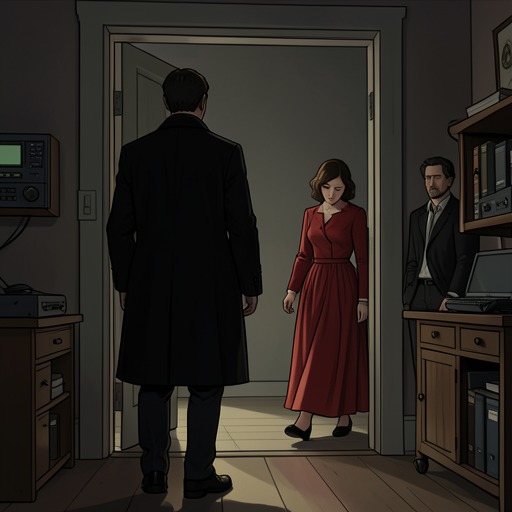
Mieze went to Freienwalde to protect a friend. The account identifies the destination and her purpose, but does not supply a complete, independently witnessed sequence of the encounter that ended in her death. At the trial, Franz says he suspects that Mieze resisted Reinhold and that Reinhold killed her in a fit of rage. This is Franz’s explanation, not a scene the narrative confirms through direct observation. The court identifies Reinhold as the murderer, but the precise immediate exchange remains mediated through later testimony.
The trial records the crime as the murder of Emilie Parsunke, from Bernau, on September 1, 1928, in Freienwalde near Berlin. The difference between that official name and the name by which Franz knew her gives the case two registers: Emilie Parsunke is the woman entered into the proceedings, while Mieze is the beloved person Franz remembers.
The search and recovery
The investigation first turns on disturbed ground in the forest. Police officers bring spades, and Karl the tinsmith indicates a hollow where the earth appears to have been recently moved. The search finds signs that something has been buried, including a scrap of pink material, but the body is not recovered there. Karl’s insistence that the officers keep digging does not settle what happened; instead, the failure to find Mieze intensifies suspicion and leaves the search unresolved.
The magistrate questions Karl about his contact with Mieze and Reinhold. Karl says that Mieze was alive the last time he saw her, during the afternoon, and that he was not with her later that night. He also admits that he helped Reinhold carry her. When asked where he went afterward, Karl explains that Reinhold gave him a passport and money, and that he left so he would have an alibi if the matter came to light. Karl’s account thus places him in the handling of the body while distinguishing that act from the killing. His willingness to help Reinhold had been bound up with friendship and payment; his later cooperation with the authorities follows a separate rupture between the two men.
Two days later, Mieze’s body is found about a mile from the first hollow. Two horticultural workers come forward after seeing a broad-shouldered man carrying a heavy box through that part of the forest and later sitting in a hollow. Their report directs the police to search likely hollows. In one, officers uncover a cardboard box containing women’s clothing; soon afterward, a box is found in another hollow with Mieze’s body inside, tightly bound with window-blind cord. The workers’ account, the disturbed ground, and the recovered box form a chain of clues, but the investigation still depends on statements by people connected to the crime.
Accusations and the trial
Once police question Reinhold, he recognizes that suspicion is closing in and turns it toward Franz. He argues that Franz could have been responsible and that Karl’s evidence does not prove Reinhold’s guilt. He then warns Franz that Karl has informed on the group and urges him to disappear. Franz leaves within a quarter of an hour; Reinhold helps him pack and accompanies him to Wilmersdorf, where Eva arranges lodging with a longtime friend. The effort to redirect suspicion therefore changes Franz’s position as well as Reinhold’s: he is drawn into the investigation and forced into flight, although he is not indicted.
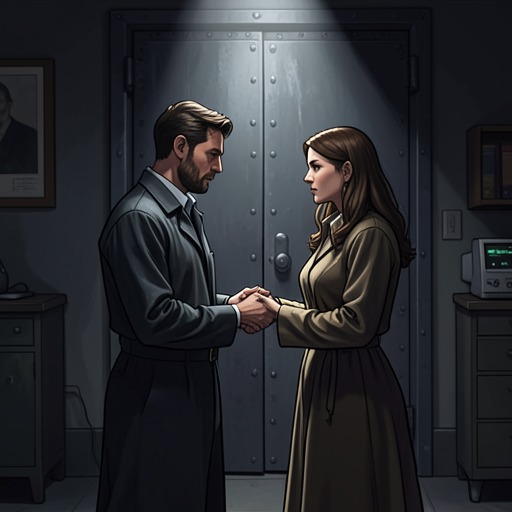
At the trial, Reinhold and Karl the tinsmith—identified in the proceedings as Matter, alias Oskar Fischer—face charges relating to the murder and to helping and abetting. Franz gives evidence after being judged recovered and fit to be cross-examined. He says Mieze had no affair with Reinhold, describes himself and Reinhold as friends, and attributes Reinhold’s conduct to his destructive compulsion to pursue women. Asked whether he knows of sadistic tendencies, Franz does not claim certainty; he offers his suspicion about what may have provoked the killing. When questioning turns to Reinhold’s youth and drinking, Franz answers only within the limits of what he knows.
Franz refuses to discuss other matters that could clarify his relationship with Reinhold, including his injured arm, their quarrel, and their fight. The silence leaves parts of their history outside the courtroom even as Franz’s testimony helps explain his view of the crime. He is not indicted, and his appearance as a witness does not dissolve the personal attachment that complicates his judgment of Reinhold.
Loss, evidence, and narrative significance
The account of Mieze’s death insists on the gap between the person she was to Franz and the official handling of her remains. After the body is recovered, procedures of identification and documentation transform her into part of a criminal investigation. A wax likeness preserves her appearance as an exhibit, but preservation is not restoration: the image stands for the woman without returning her to her relationships or her life. The contrast makes the investigative process necessary yet chillingly incomplete. It can establish evidence and identify a victim, but cannot undo the loss or fully contain what she meant to those who loved her.
The murder is narrated alongside the ordinary machinery of Berlin life rather than enclosed within a single crime scene. Elsewhere, the text lists tram routes and fares, describes the roadworks at Alexanderplatz, and returns to the pile driver striking the ground near Aschinger’s. These public rhythms—transport, construction, commerce—contrast with the hidden movement of a body through the forest. The contrast does not explain the crime; it situates private violence within a world that continues to circulate and work around it.
Mieze’s death also reorganizes the relationships around the case. Karl’s account exposes his paid assistance to Reinhold and his later decision to inform on him. Reinhold’s accusation sends Franz into hiding, while the trial brings Franz back into public view as a witness rather than a defendant. For Franz, however, the proceedings do not turn Reinhold into a stranger. The case supplies a legal account of murder, but Franz’s restrained testimony and continuing attachment preserve an emotional contradiction the verdict cannot settle: the man he regards as a friend is also the man held responsible for Mieze’s death.